Artificial Intelligence
The AI Information Avalanche
The ever growing volume of AI-generated development artifacts needs special evaluation and metrics beyond or instead of code analysis
Transform AI code generation into true software engineering using feedforward requirements and automated feedback on the quality of generated code & artifacts.
In previous blogs, we discussed how deep software analysis platforms such as DETANGLE identify structural bottlenecks, architectural hotspots, and emerging technical debt in complex software systems. Traditionally, these insights have been used to support human architects and engineering teams.
In the era of AI-assisted software development, however, these insights should no longer stop with the human developer. They should become part of an automated feedback loop that continuously guides the AI itself.
Whenever code analysis detects architectural drift, increasing coupling, design violations, or maintainability risks, these findings should be fed directly back to the AI coding agent. Instead of merely reporting problems after they occur, software analysis becomes an active guidance mechanism, enabling AI agents to refactor, improve, and align their output with the project's architectural goals.
In this model, automated code analysis becomes the feedback sensor for AI-generated software.
But code quality is only half of the equation.
As this article has shown, AI systems continuously generate a growing body of development artifacts—requirements, specifications, Architecture Decision Records (ADRs), documentation, context files, engineering rules, and other forms of engineering knowledge. These artifacts are no longer just supporting documentation. They become part of the project's operational knowledge base and serve as guidance for AI to create the next generation of code and artifacts.
Consequently, these development artifacts must be governed with the same rigor as source code. They require continuous analysis, dedicated quality metrics, and automated feedback mechanisms of their own.
The next generation of AI software engineering therefore requires a second feedback sensor: one that continuously evaluates the quality of AI-generated development artifacts. Such a system should detect redundancy, inconsistencies, missing traceability, outdated information, and contradictory guidance before these artifacts become part of the AI's future context. The right feedback loop of the picture below captures this aspects.
At Cape of Good Code, we believe this is the next major step toward AI-native software engineering, and we are actively developing tooling to make this vision a reality.
Feedback alone, however, is not enough.
Every effective control system also requires high-quality feedforward input. In AI-assisted software engineering, this begins with Requirements Engineering. Well-structured requirements, their refinement and break-down, and a clear architectural vision provide the guidance that enables AI coding agents to make sound implementation decisions from the outset.
Ironically, Requirements Engineering has received relatively little attention in discussions about AI coding. Yet it may become even more important than in traditional software engineering. AI can generate software at unprecedented speed—but only when it is guided by requirements that are precise, consistent, and reducing unambiguity by taking a structured approach of refinements.
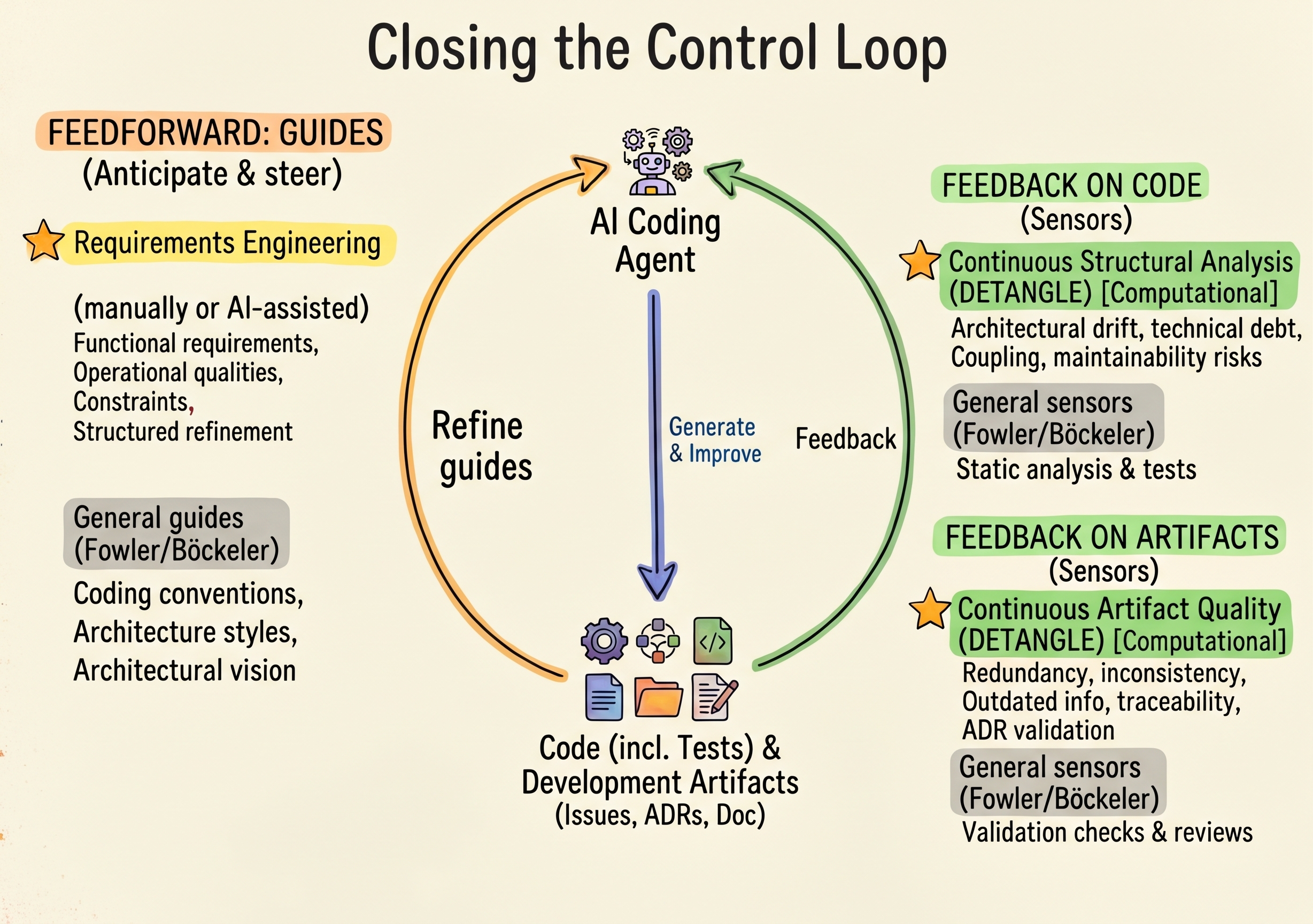
Figure* Complete Control Loop: incl. "FEEDBACK ON ARTIFACTS" and "FEEDFORWAD: GUIDE Requirements Engineering"
The future of AI-assisted software engineering therefore rests on three complementary pillars. The feedback loops presented by Fowler/Böckeler need to be extended to a Complete Control Loop in the following way:
Only when these three mechanisms work together does AI move beyond autonomous code generation and become a trustworthy engineering partner capable of continuously improving both the software and the knowledge surrounding it.
This shift fundamentally changes how software quality should be evaluated—both during day-to-day software development and in strategic software acquisitions by investors.
Software projects should no longer measure AI productivity solely by lines of code or completed tickets. Instead, development pipelines should include automated quality gates for both source code and AI-generated development artifacts. A previous AI-generated Architecture Decision Record (ADR) that contradicts a latest architectural decision or newly generated code should be treated no differently from a failing unit test.
The same applies to Technical Due Diligence. In the age of AI-assisted software engineering, evaluating source code alone is no longer sufficient to assess the long-term value and maintainability of a software asset. Investors and technology leaders must also evaluate the health of the AI-generated engineering knowledge that surrounds the code.
The critical question is no longer simply:
"Is the code maintainable?"
It is becoming:
"Can both humans and AI continue to build on this engineering knowledge with confidence?"
Tomorrow's legacy systems will not fail because of bad code alone. They will fail because the AI-generated engineering knowledge surrounding that code has degraded to the point where it can no longer provide reliable guidance—neither for human developers nor for AI agents.
The future of AI-assisted software engineering is therefore not about replacing software engineers with AI. It is about creating engineering control loops that combine high-quality requirements, continuous feedback on source code, and continuous feedback on AI-generated development artifacts. Only then can AI evolve from an unreliable code generator into a human-guided, self-correcting engineering partner for large systems.
Managing the AI Information Avalanche by software engineers is therefore not just a documentation problem. It is part of the next software engineering discipline.
These insights are also shaping our own research and development roadmap at Cape of Good Code. Today, DETANGLE provides deep structural analysis of source code and delivers actionable architectural feedback. Our next focus is to extend this analytical approach beyond the code itself—to the growing ecosystem of AI-generated development artifacts that increasingly drive both human and AI-assisted software engineering.
We believe that future engineering platforms must continuously evaluate not only code quality, but also the quality and long-term health of the engineering knowledge surrounding that code. Only by combining these capabilities can AI-assisted software development meet expectations and remain scalable, trustworthy, and sustainable.
[0] Photo by Jules Clark: : Photo by Jules Clark: https://www.pexels.com/photo/levers-and-compass-on-dashboard-18681300/
* The Figure "Complete Control Loop" has been generated by using AI
The ever growing volume of AI-generated development artifacts needs special evaluation and metrics beyond or instead of code analysis
‘Architecture drift’ also applies to AI-generated code. We need innovative methods, including AI, to design software architectures that are...
Cape of Good Code's software analyses provide data-based help in allocating the ever-scarce development resources in software engineering